Students designing classes, you say?

Last semester, inspired by Caleb McDaniel and Tim Burke‘s student-designed courses, I let students design the content of my Death in the Digital Age course.  Then I wrote a post about it for EdSurge. Here, a few months later, is the text of that post.

Last semester, I ceded control of class to my students. I didn’t just give them room to speak. I asked them to design the syllabus, the assignments and even the grading rubrics.

As the semester progressed, these students gained experience forging connections among different interdisciplinary fields. By selecting the topics that the class would explore, they built confidence in their own expertise and embraced the uncertainty of using new digital tools to communicate their work.

Why Give Students the Reins?

“But!”—my colleagues asked—“Didn’t the students hate the deconstruction of faculty expertise? How could they be trusted to do rigorous work if they were designing assignments? Wouldn’t they just do the minimum required?”

The class I was teaching, Death in the Digital Age, was totally new for me. It was prompted by my own research questions about the relationships between death, data and ghosts, and a desire to read deeply beyond my own expertise. To explore these big and often complex questions, the class would have to encompass recent developments in science and technology studies, medical humanities, biology, sociology and anthropology, as well as my own fields of digital studies and history. The students enrolled in the class came with interests as diverse as these fields, and I knew that I wouldn’t be able to anticipate all (or even most) of the intersections between the themes of the class and students’ own fields of study.

I also wanted to see what kind of digital historical projects students would produce when prompted to bring together disparate data points about an individual as a kind of “resurrection.” In order for these projects to work, this class would have to surmount a pedagogical problem common to digital humanities courses: Digital projects feel scary in ways that traditional papers do not. Many students know how to write papers. They are, understandably, much less comfortable with digital assignments (e.g., digital archives, interactive exhibits or games-as-scholarship), new tools (e.g., Omeka, Twine or d3.js) and new forms (e.g., hacks, glitches or directed play).

I wanted the class structure to help students manage their (productive) discomfort with new tools, while also introducing them to the new (and possibly discomforting) field of death in the digital age. I faced the prospect of discomfort building upon discomfort, with no productivity in sight. Taking my cue from Rice Associate Professor Caleb McDaniel’s work on student-driven classrooms, I decided guard against the possibility that this class would leave students feeling unmoored by giving them control over the conceptual boundaries of the course.

I broke the class into three parts: (1) Building the course, (2) Theorizing digital death and (3) Digital resurrection. The bulk of the first few weeks was devoted to thinking about how to build digital humanist communities, design digital assignments, and support (without co-opting) student agency. I asked students to list topics they wanted to see covered in the course. As a class we then discussed, and decided on, the themes we wanted to pursue together. Some, such as the advent of digital memorials to the dead, were ones that I had expected. Others, such as the phenomenon of digital memorials for fictional characters, were ones I had not. I asked students to bring in expertise from their own majors and classes, and I provided expertise in the form of finding readings that fit the topics suggested.

Having students shape the content of the course worked well, but I wanted to go farther—I also wanted them to feel like they had agency in terms of their intellectual output. So I asked them to look at digital projects that they liked, and to come up with a set of best practices for digital scholarship. These collaborative best practices became the beginnings of their midterm assignment.

As a group, the class decided that the best digital work was relevant to contemporary politics, publicly oriented and collaborative. I suggested various tools they might use to build such a project, but they ultimately settled on Tumblr, which fell within their digital vernacular but was outside of mine. The resulting assignment collected and contextualized artifacts of digital death, and brought them together in conversation with one another. (For instance, the students drew inspiration from the Queering Slavery Working Group project, which uses Tumblr to aggregate “histories of intimacy, sex and sexuality during the period of Atlantic slavery.”)

The semester progressed. The students seemed to get comfortable with the idea of a course that they were complicit in. Their final was a fairly broad prompt: Digitally resurrect someone from Davidson’s past. Before starting the students had to construct two documents. The first was an assignment for themselves, written from the perspective of the professor. Then they developed a grading rubric, “hacked” from a rubric I use to grade student papers. Each assignment and rubric was different. Students would be assessed according to the individual standards they set.

Positive Results

Some students were initially uncomfortable with the idea of a professor abdicating responsibility, but the class did not implode and students did not rebel. In the end, they liked that the course we all participated in was unique—it will never be taught in just this way, with just these readings, topics and assignments ever again. This uniqueness made the students feel as if we were all working toward some intellectual end together, rather than feeling like they were working toward some unknowable standard I was setting.

In contrast to other digital studies classes, there also seemed to be less resistance to learning new tools and technologies. In part, I think, this was because the students felt free to choose tools that suited their projects, rather than being expected to master a tool that they would never use again.

One student used Instagram to recreate the movements of a former Davidson employee through the space of the town and college in order to argue that people who have worked for institutions should be remembered for more than their service. Another student used Timeline JS to recreate the final days of Fred Martin Hobbs, a student at the college who died trying to save a classmate from drowning. In both cases, students felt empowered to select the stories they wanted to tell. Rather than feeling compelled to demonstrate proficiency in a particular tool, and finding a narrative that was easy to convey, students mindfully chose tools that helped them to tell particular stories.

Would I Cede Control Again?

Yes. However, this is not a model that works for all (or even most) classes. The combination of a relatively unknown topic, with a relatively underdeveloped literature, and a lot of new technologies worked to create circumstances that seemed to require teaching in a way that made students feel more secure about their control of and place in the class. Student control of the classroom might not work so well for classes in more established fields, and certainly would be less effective in classes with more familiar assignments.

The whole class was not smooth sailing—at times students and I disagreed about the direction the class would take, and clashed over differing opinions about the right tool for a particular narrative job. Despite these moments of friction, I found that the work that students created felt more thoughtful than that submitted in other digital studies classes I’ve taught. Students were able to articulate why different digital methods afforded the telling of stories in particular ways, and developed critical perspectives on the study of death in the digital age. The benefits far outweighed the frustrations (for me at least) and structuring a class with student agency at the core is certainly an experiment I’ll try again.

Digital History “From Below”: a call to action (and an abstract)

I’ll be heading to Kraków this summer for DH2016 – here’s the paper I’ll be giving.


Humanists – inclusive of digital humanists – are preoccupied with telling stories. Some of our most interesting subjects, however, have left only the barest of marks on historical records. Their stories are among the most captivating, but also some of the most difficult to access. This paper knits together recent trends in digital humanities practices that have helped us to elevate unrepresented voices with a discussion of how to elevate the marginalized within the DH community. It showcases select projects that undermine archival silences.[1]   It then argues that digital humanities practitioners should add these theories to the collection of tools currently used to forward social justice projects in DH spaces.


Elevating the Archivally Silenced

Various methodologies have been adopted to address the problem of how to tell stories about people who left behind few records.   In the 1970s and 1980s, practitioners of “history from below” worked to elevate narratives about “people with no history,” by chronicling the everyday lives of peasants and non-elites.   At the same time, practitioners of the “new social history” turned to cliometrics – and adopted methods that would be familiar to those who work with “big data” today – to highlight trends about marginalized peoples from historical data like censuses, probate records and financial documents.


There have been various resurgences and developments in these methods in the intervening four decades. These include practices of reading archives “against the grain” to get at the unstated assumptions that historical actors made about those they held power over.   They also include theoretical approaches that advocate the reading of silences to understand those whose voices were intentionally obscured by official recorders and gatekeepers.


Marginalizations Within DH

Questions about whose voices are elevated and whose are silenced have also long been a theme in DH scholarship and discourse. These questions seek to unpack the ways in which DH as a field is exclusionary. This former is a much (though still not enough) referenced problem in panels at former DH conferences, which have asked how DH research can address (and remedy) social problems.


Digital humanities scholarship has also begun to address problems of access within the broader DH community, and the barriers erected to women and people of color in particular. For example, Adeline Koh has argued that we need to examine the ways in which DH publics are constituted, in order to better understand the creation of “limits of the discourse that defines the idea of a digital humanities ‘citizen.’”   Similarly, Tara McPherson has argued that we must see the evolution of DH as a field shaped by structural inequalities – of race, class and gender – which accompanied the rise of computation technologies.


A Knitted View

These are much needed interventions, and help us to understand the evolution of our field as one in which certain groups have been marginalized and others have been centered. These conversations also mirror methodological debates within history about whose voices to elevate, and under what circumstances. This paper complements extant work by arguing that theoretical interventions concerning current structural inequalities must be brought to bear on the past, and that digital methodologies are ideally suited to elevating subsumed voices in the present. It further demonstrates that these projects, the theories that underlie them, and current work to make DH more equable should be read together to further the practice of digital history and humanities “from below.”


Bastian, J. (2003). Owning Memory: How a Caribbean Community Lost Its Archives and Found Its History. Westport, Conn.: Libraries Unlimited.

Bhattacharya, S. (1983). ‘History from Below.’ Social Scientist, 3–20.

Farge, A. (2015). The Allure of the Archives, New Haven: Yale University Press

Fuentes, M. (2010). Power and Historical Figuring: Rachael Pringle Polgreen’s Troubled Archive. Gender & History 22, no. 3: 564–84.

Gallman, R. (1977). Some Notes on the New Social History. The Journal of Economic History 37, no. 1: 3–12.

Koh, A. (2014). Niceness, Building, and Opening the Genealogy of the Digital Humanities: Beyond the Social Contract of Humanities Computing. Differences 25, no. 1: 93–106. doi:10.1215/10407391-2420015.

McPherson, T. (2012). Why Are the Digital Humanities So White? Or Thinking the Histories of Race and Computation. in Gold, M (ed) Debates in the Digital Humanities. Minneapolis, MN: University of Minnesota Press.

Trouillot, M. (1995). Silencing the Past: Power and the Production of History. Beacon Press.


[1] These might include work like Ben Schmidt’s, elaboration upon late twentieth-century cliometrics and use of “big data” methods to explore historical sources (http://benschmidt.org/projects/digital-humanities-research/); maps like Vincent Brown’s “Slave Revolt in Jamaica” which uses sources produced by slaveholders to argue for the agency and tactical prowess of enslaved people (http://revolt.axismaps.com/map/); and Michelle Moravec’s use of metadata to “unghost” lesbian women in the past (http://michellemoravec.com/).

Davidson’s Imbibable Past

{Cross Posted on the Davidson Archives blog}


Lewis Bell came to Davidson College in 1865 and graduated in 1870. Though he was a student during the Reconstruction Era, it is likely that most of his college experiences were mundane. He was a member of the Eumenean Literary Society. Among his papers held in the college archive is a donation request from the society from the year after he graduated. Like many Davidson students, he also seems to have been concerned with his grades. His papers also contain a list of Davidson College students and their grade averages from 1865 to 1868. We know little more about Bell’s time at Davidson, except that he also seemed to have an interest in spirituous liquors. A final item in the John Lewis Bell collection is a well-used recipe for “Mother’s Bitters,” which was comprised of “tanzy, Wormwood and Barbary Root, a good handful of Star root, the same of Columbo and Chamomile.”

DC0305s001

Bitters are an aromatic flavoring agent, made by infusing roots, bark, fruit peels, herbs, flowers and botanicals in alcohol. These spirits are used in fancy craft cocktails today, but were historically put to more medicinal purposes. In his history of bitters, Brad Thomas Parsons situates these infused spirits in a long history of “a cure for whatever ailed you” – beginning with Stroughton Bitters, which were patented in 1712, and which contained “1/2 drachm cochineal, 1 pint alcohol, ½ canella bark, ½ ounce cardamoms” and were made by being left to “stand eight days; draw it off clear and bottle it. For medicinal purposes use French Brandy instead of alcohol.” (From Monzert, Leonard. The Independent Liquorist: Or, The Art of Manufacturing and Preparing All Kinds of Cordials, Syrups, Bitters, Wines … John F. Trow & Company, 1866.)

Why would Bell have kept a recipe for bitters amongst his Davidson paraphernalia? He might have been keen on bitters for recreational imbibing purposes. Americans were certainly interested in mixed drinks during the years that Bell attended Davidson, and cocktails had a long history. People in England in the eighteenth century were known to mix patent bitters with brandy, and by 1806 the word “cocktail” had developed to mean “a stimulating liquor, composed of spirits of any kind, sugar, water and bitters.” However, in the latter decades of the nineteenth century, Davidson College was very concerned with limiting students’ access to alcohol. It prohibited the sale of alcohol in college-owned properties, and brought suit against stores that sold spirits to undergraduates. Perhaps Bell was unable to buy bitters for cocktails in the town, and had to resort to making them himself.

Bell might equally have been using “Mother’s Bitters” as a patent medicine. In the late nineteenth century bitters were sold as a remedy for all manner of ills. In 1866, the American Agriculturalist noted that bitters could aid in “weak digestion or a debilitated state of the system, if properly taken under medical advice.” Similarly, Rowney in Boston (1892) spoke to the benefits of “mother’s bitters, made of dandelion root, and such wholesome things.” In her study of alcohol and botanicals, Amy Stewart writes that from the eighteenth-century forward, people “realized that adding wormwood to wine and other distilled spirits actually improved the flavor or at least help disguise the stench of crude, poorly made alcohol.” Chamomile, barberry root and tansy also have practical purposes – all work as anti-inflammatories, and chamomile additionally works as a sedative. The combination of herbs in “Mother’s Bitters” consequently seem to have been medically beneficial. Perhaps Bell was in need of an anti-inflammatory, or means of calming an upset stomach. There were several stores on Main Street in the 1870s that might have sold bitters, but the college’s prohibition against the sale of alcohol might just as well have prevented Bell from purchasing them in town.

The Scofield Store was one among a few stores that might have sold bitters on Davidson’s Main Street.

So, while he might have been collecting recipes in order engage in an illicit cocktail culture, Bell might also have been trying to make a well-known remedy for a “weak destitution” or “debilitated system.”

Although Bell’s use of the “Mother’s Bitters” recipe can never be known, we can still get at Bell’s experience. I recreated Bell’s recipe, using dried herbs and roots, and steeped the whole mixture in alcohol for two weeks. The resulting concoction was distinctly flavored. It didn’t taste like the bitters we use in cocktails today. Rather, it had an anise flavor, not dissimilar from pernod. This is due to the combination of wormwood (which, on its own has a menthol-like flavor), tansy (which tastes like peppermint), chamomile, barberry root, and star anise (which has a warm flavor, and was often included in absinthe along with wormwood). On a recent Monday night, a group of faculty and staff drank our “Mother’s bitters” in seltzer. We experienced it as a largely medicinal taste, and found that the smell of wormwood did indeed obscure other scents. While knowing what the bitters taste like doesn’t get us much closer to Bell’s everyday experiences of Davidson, it does help us bridge the divide between the 1870s and the present, and to imagine how a Reconstruction-era Davidson student might have imbibed.The finished bitters

An agentic moment

This week I assigned Jeff McClurken’s article on Omeka and “productive discomfort.”  I’ve had students read this article before, and while the resulting conversation was interesting, the article has never before resulted in the kind of robust debate about discomfort, barriers and technology that came out of the reading response blog posts for today’s class.

I could summarize, annotate and curate their posts, but (drawing on Andrew Rikard’s recent argument about student agency) I thought it might be better to just leave links here.

Love in Peril

“That Belongs in a Museum”… or an Omeka Exhibit

Preservation through Representation

The Digital Difference

Egalitarianism of the dead

We’ve reached the half-way point in the semester, which means that my students have turned in and received midterm grades (for this Tumblr archiving and contextualizing examples of digital death) and I have received my midterm course evaluations.  One of the requests for the second half of the semester is that the learning goals of the course be updated to reflect progress so far.  This has gotten me to thinking about what I’d *like* them to answer if faced with Caleb McDaniel’s (excellent) course eval question  – “what is the most important thing you have learned in this class?”

For me, one of the most important theme of the semester has been the ways in which structures of power and inequality play out, even in death.  This should come as no surprise.  Power, deployed through assumptions and expectations about gender, class, race and more, shapes most aspects of our lives.  It is in no way shocking that it might also shape our deaths.

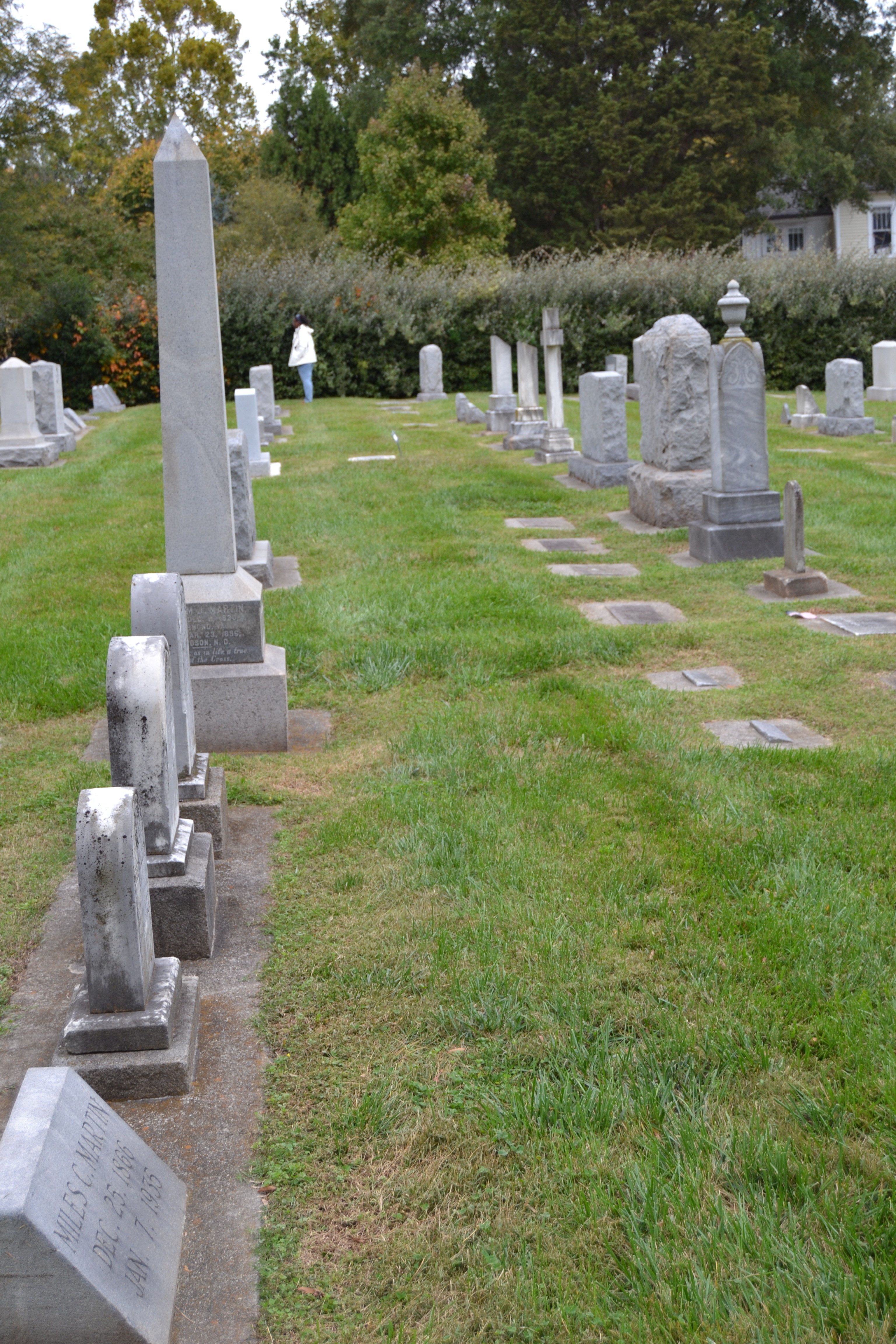
These structures of death and inequality were made visible in a field trip we took today to the Christian Aid Society cemetery.  This block of land – carved out of the farm of a local elite in the early 20th century – contains graves that date back to the early 1910s, but is also a still functioning grave yard.  Most of those interred here are African American, and while some worked for the college, it is not official college space.  It is an evocative place – the stones are not ordered in neat rows, and more than a few are marked “unknown” or with the small metal plaques that funeral homes leave as temporary stand-ins for gravestones, but which remain the only identifier for years-old graves.

Christian Aid Society Marker

Christian Aid Society Cemetery

This cemetery stands in marked contrast to the space owned by Davidson College, which is reserved for those affiliated with the College.  As a result, without any overt policy of class or racial segregation, it is space in which overwhelmingly white and elite people are interred.

Davidson College Cemetery

While I hope that these students leave the semester with a better grasp of how theory has practical application, with some understanding of what it means to memorialize and learn, I hope that one of the biggest take-homes will be about the ways in which structural inequalities manifest in death and how those inequalities in turn shape the production of historical sources, the curation of archives, the preservation of some materials, and the neglect of others.

New directions in disasters and resistance

Last week I had the pleasure of moderating a panel at the American Studies Association.  We ended up running our panel as an (incredibly generative {for me, at least}) workshop, so I didn’t formally give my comment.  I like some of the ideas in it though – enough for this maybe to be the germ of an historiography article, so I thought I’d share it here.


d3.js + R > Gephi (or, why network analysis helps with history)

Gephi is a very useful tool.  I’m very much looking forward to the new release that seems always on the horizon.  In the meantime, though, every time I open Gephi it crashes, and then I dive down a long rabbit hole of trying to re-write the program code, and then I get angry and go home.  So I’ve been delighted to find that a combination of R (for manipulating and analyzing the data) and d3.js (for visualizing the data) does most of the work of Gephi with much less frustration.

I’ve been using Kieran Healy’s work on Paul Revere and network centrality and applying it to a cohort of men who served on the boards of philanthropic organizations in New York in the 1840s. I am particularly in the officers General Relief Committee for the Relief of Irish Distress of the City of New York. These men – Myndert Van Schiack, John Jay, Jacob Harvey, George Griffin, Theodore Sedgewick, Robert B. Minturn, George Barclay, Alfred Pell, James Reyburn, William Redmond and George McBride Jr. – were deeply politically connected, but don’t seem to have had much of a relationship to one another.

Healy’s script, and Mike Bostock’s d3 blocks helped me to build a matrix which tracked relationships between philanthropists via organizations, making note of the number of organizational connections that different pairs of men shared; and another matrix which tracked relationships between philanthropic organizations and social clubs via philanthropists, making note of the number of men that each organization shared.  I used the former to build a force-directed network diagram, which, in combination with some R based analysis, suggests that while the New York Famine Relief Committee officers didn’t often serve on other committees together, they shared other social connections.

For example Jonathan Goodhue was not a member of the famine relief committee, but served on other committees with nearly every General Relief Committee officer.  Of the New York famine relief committee members, Jacob Harvey was the most centrally connected member.  This data has pointed me in some new archival directions, but also give a much better sense of the ways in which people were connected to one another than comparable textual descriptions might do.


I also built a network diagram showing relationships among different newspapers reporting on the famine, which cluster newspapers more inclined to cite each other.


[Trigger Warning]

‘Tis the season for making spring semester syllabi, and I thought I’d share the trigger warning statement that I’ve developed over the past year or so.  I’m sure it’s far from perfect, but I’m hoping that it addresses the needs of students who do have PTSD (or other traumatic) reactions, while still maintaining a rigorous classroom environment.  Many things have been written about trigger warnings, and I tend to fall into the camp of thinking that the good they do for students who really need them is bigger than the harm caused by students who abuse them.  So far, this policy has worked fairly well (at least, from my perspective) – allowing students the flexibility to attend to their own mental health while unpholding accountability.


Triggers:

There has been a lot of discussion recently about “trigger warnings” – indicators that something so disturbing as to make participation difficult (i.e. death, dismemberment, assault, gore) will be covered in a particular class. To the best of my knowledge, we will not be dealing with these types themes in this class, but the history of [class topic] can be complicated, and I can’t guarantee that any of your projects or our readings won’t brush up against something that might be triggering. During the semester, I’ll do my best to be transparent about when we’ll be engaging with issues that I anticipate might be particularly troubling, and I ask you to come see me if you have any concerns about topics that might actively disrupt your ability to participate in this course. If such issues do arise, I will work with you to find alternate assignments, or to strategically pick which classes to skip. Remember that you may skip up to three classes with no attendance penalty, and that you are free to use those absences for whatever purpose you wish – inclusive of potentially triggering material. [my school mandates that student athletes be allowed to miss a certain number of classes depending on the frequency of course meetings – I extend this to all students]

Some more almshouse data – admittors vs. diseases

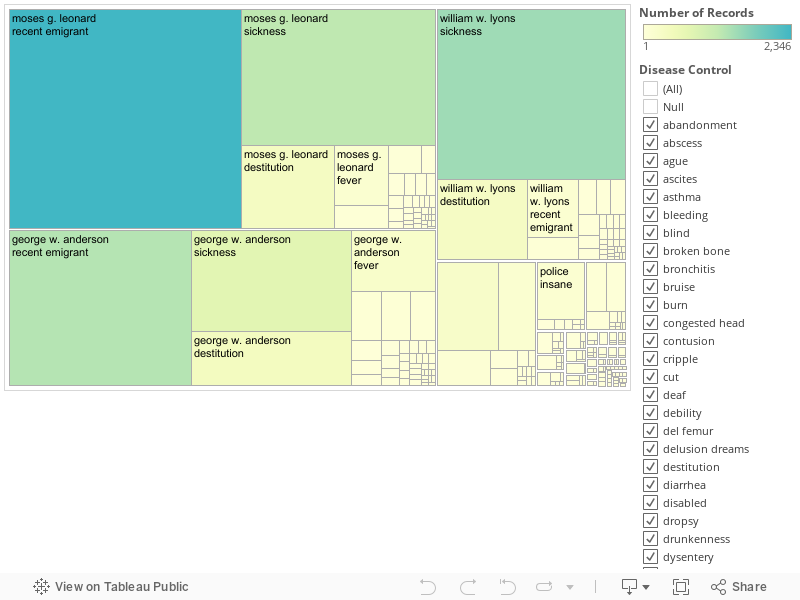
I am almost done cleaning the almshouse data – the past few days have been spent tracking down the “admittors” – those men (and they were mostly men) who were responsible for sending the destitute and sick of New York to the Bellevue Almshouse. These men were recorded in the almshouse register in the column “by whom sent” and I’ve long been interested in how the identity of the sender related to other aspects of Bellevue admittants. Was one admittor likely to flag one disease more than another? Send patients to one public health site over another? Were admittors from different wards more or less likely to send people in their districts to Bellevue?


I’ve just finished processing the “by whom sent” data, and while more work remains to be done, I thought I’d share a visualization that correlates the person responsible for dispatching inmates to the almshouse, and the reason they were sent:  The selection columns on the right and left allow filtering by disease.

Up next: mapping admissions by ward.