Demoing the Digital Almshouse

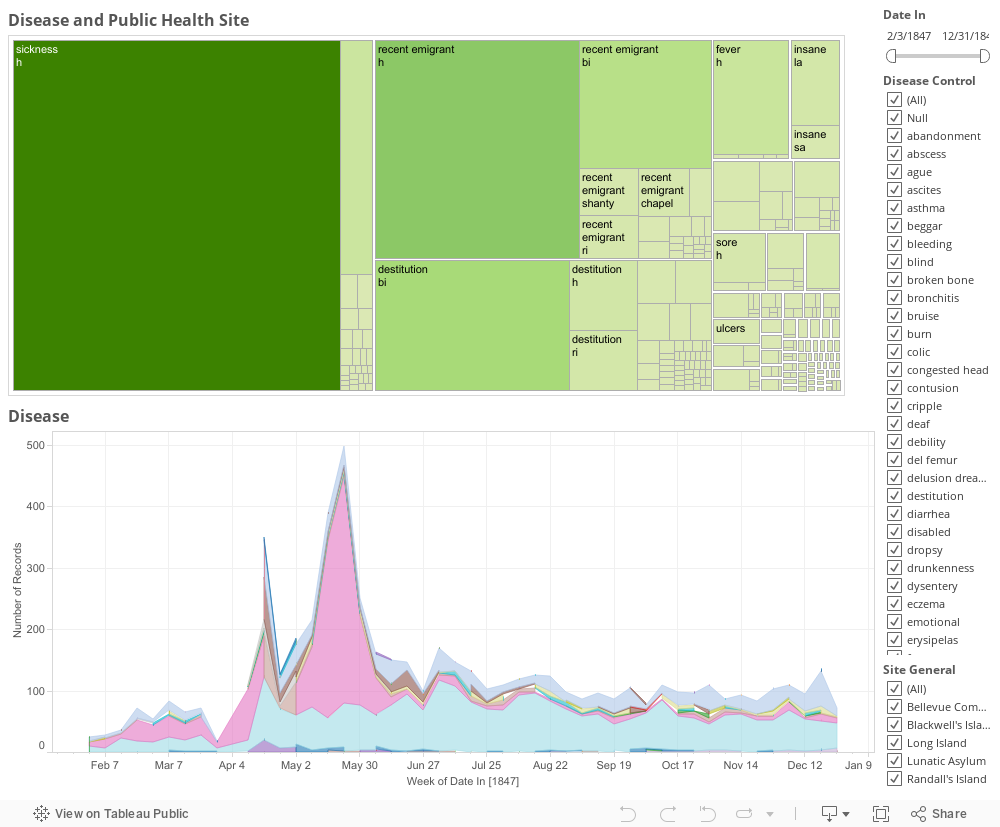
For the past few months, first at HILT and then at Davidson, I’ve been working to clean and process the Bellevue Almshouse Dataset.  The data is not quite ready to go live – I’m still writing data dictionaries and README files – but I recently got to sit in on a demo of Tableau, and thought I’d use it as an excuse to visualize some of the attributes of the data that I find most compelling – the relationship between the professed (or attributed) “disease” of almshouse inmates and the site within New York’s public health system to which they were sent.  I have an idea about the influx of Irish immigrants in the nineteenth century forcing the development of a more robust public health infrastructure, but in order to get at the significance of institutional changes in the post-1848 period, I need to have a much better sense of what happened in the first half of the 1840s.

So I built a thing!  A thing that visualizes the relationship between time, site and disease:


From the archive

From the Antigua Observer of July 22nd, 1847:

BRITISH OFFICERS ROASTED ALIVE AND DEVOURED BY CANNIBALS – A letter has been received in London, from an officer of H.M. war steamer Driver, detailing the particulars of an engagement between the British and the New Zealanders, in which ten men of the Carton frigate were killed, and thirteen wounded, exclusive of several men of the 89th regiment.  The savages roasted alive two European officers, whom they devoured.  The writer adds the additional melancholy intelligence of Lieut. Philpotts, the son of the Bishop of Exeter, having been scalped, roasted and eaten by the Zealanders.  Shortly after his melancholy fate, the eye glass of the gallant officer was found hear the spot where he was murdered and devoured.

A year of #dh and the Davidson archives

(Cross-posted at Around the D)

Over the past two semesters, I’ve had the privilege of trying out some new course ideas that blended digital humanities and archival work.  The challenge of bringing #dh into archives and archives into #dh is that it can actually be quite a chore to translate historical data – as transcribed in minute books, maps, or letters – into a form that works for #dh visualizations and research.  This year, I had two students whose projects used “analog” material from the Davidson Archives to create interesting and captivating digital artifacts, each of which showcased something new about Davidson history.  These projects speak for themselves, but I thought I’d say a little about the process that each undertook to get from poring over manuscripts in the rare books room to these digital explorations of Davidson’s past.

Mapping Davidson’s Environmental History

Sarah Roberts, a senior Environmental Studies major, undertook the impressive task of charting Davidson’s environmental development over time.  Using maps like this one

Davidson shrubbery, 1983-4

– and many more besides, she created a series of visualizations that documented different aspects of Davidson’s environmental history at different points in time.  This was not an easy process.  For each of the maps she used, she had to trace the outlines of important features (buildings, athletics fields, a briefly-present lake) and color code them according to their purpose.

She brought all of these together in an environmental studies capstone project, but also in a dynamic website which takes users through the spatial history of Davidson College and a bit of the town.


Mapping Davidson’s Institutional History

Avery Haller, a senior anthropology major also used the Davidson archives, but instead of tracking Davidson’s spatial history, she was interested in the college’s social and institutional history.  Avery used the minutes of the Concord Presbytery, the Presbyterian group which was prompted by “the closing of Liberty Hall Academy (now Washington and Lee University) due to a massive fire” to found “a new place close to home to send their young men to school.”

Using documents like this one (which, happily, were transcribed):

Concord Presbytery Minutes-March 1835


she was able to extract social networks – the ties that bound the various men (and they were all men) involved in Davidson’s founding together. (She describes the technical part of this process here)


The finished network

Ultimately, Avery concluded that both a close reading of the sources and a systematic analysis of connections among Davidson’s founders revealed “a picture of Davidson … that blend[ed] conservative values and an entrepreneurial spirit.”


Together, these projects point to the innovative work that can emerge when traditional historical materials are deployed in new ways.  However, both of these projects took an extraordinary amount of time to accomplish – since before they could begin their analysis, both Avery and Sarah had to render historical “data” legible for digital tools.  As one student noted in my class’s final presentations “As most of you have found, data entry is kind of tedious,” but I hope that these projects can help convince students and researchers alike that the intersection of #dh and archives can lead to some fruitful and interesting results.

(text)mapping Typhoid Mary

The inimitable David McClure came to Davidson last week to talk to students and faculty about Neatline, things DH and app development.  While speaking in Mark’s class, he introduced textplot – a neat little tool that produces a co-occurrence network of words in a text, depending on whether they occur in proximity to one another. I’m working on a Neatline map of George Soper’s account of his role in the pursuit and medical incarceration of Mary Mallon – better known as Typhoid Mary – but I hadn’t thought much about Soper’s text as a literary text – I’d been treating it much more as a spatially oriented primary source.

Here’s a first stab at running textplot over “The Curious Career…” – it’s an oddly rambling visualization because the text itself is so short, and proceeds at such a rapid clip.  Soper does not often return to a theme he has already introduced, leaving little for textplot to pick up on in terms of recurring clusters of words. However, the centrality of some words (explained, examined) are a nice visual reminder that, despite acknowledging her humanity at several points, Soper was largely approaching Mary Mallon as a medical specimen.

Hopefully a more traditional (spatial) map of Soper will follow shortly.

Internationalizing the undergrad #dh discussion

For the past year or so, I’ve been kicking around the idea of getting folks involved in digital humanities for undergraduates together to talk about what we do differently, what we do that is the same, and how to build a set of best practices that will be useful to other undergrad #dh programs that are getting started.  I was excited to see some workshops of a similar theme at this year’s DHSI (#3 -Models for DH at Liberal Arts Colleges and #15 Digital Pedagogy Integration in the Curriculum) and thrilled to have a workshop that’s all about hashing out the issues that practitioners of #dh for undergrads face at DH2015 in Sydney this summer.

We’re looking for participants from across the disciplines and professions.  We also welcome students who want to weigh in on what a digital curriculum might mean for them.  We’re also hoping to internationalize this conversation and bring together #dh practitioners from different countries and different educational systems.  The full CFP is below, but we encourage anyone who is interested to reach out to us at startingfromscratchDH (at) gmail (dot) com.


Call for Participants:


Starting from Scratch?: Strategies for Building Undergraduate-Centered #DH Programs – DH2015 – Sydney, Australia – Workshop dates: June 29-30


Do you work with undergraduates in digital humanities programs? Want to share experiences and discuss best practices with other practitioners?


This Digital Humanities 2015 pre-conference, half-day workshop will use case studies of “start-up” undergraduate DH programs as a jumping off point for a broader discussion about whether undergraduate digital programs must indeed start from scratch at each new institution, and whether it is possible to craft a transnational document for DH best practices.


We aim to include participants from as wide a range of geographical locations and roles (faculty, students, librarians, archivists, instructional technologists, IT professionals, program directors, etc.) within DH initiatives as possible.


The central issues driving this workshop are:


  • The challenges of establishing DH programs at teaching and undergraduate-centered institutions
  • The ways in which the pedagogical needs of undergraduate institutions and undergraduate-centered DH programs differ from and dovetail with those of larger research universities
  • The role of and challenges to undergraduate-focused DH programs around the world
  • How the discussions about digital humanities taking place on liberal arts campuses relate to broader questions that animate the field of digital pedagogy


Workshop Structure

At the workshop, participants will present short introductions to their undergraduate DH programs and outline one main takeaway each.  Both organizers and participants will work to draw attention to commonalities and differences among presentations, before opening up the floor to design-thinking exercises and formal discussions designed to add material to the whiteboard scaffold.


The workshop itself will:

  • Invite participants to share different approaches to undergraduate-centered DH programs, incorporating global perspectives
  • Workshop some general solutions to common undergraduate-DH problems, share local challenges, and collaborate on strategies for particular problems
  • Define common principles and pedagogical reasoning, keeping in mind the variety and experimental nature of different initiatives
  • Explore the many different forms of undergraduate-focused digital programs
  • Chart recent developments in digital liberal arts pedagogy


In addition to sharing insights from different programs during an in-person session, this workshop also aims to codify some best practices for building and sustaining new digital humanities programs for undergraduates.  Drawing on the success of crowd-sourced best practices, we will compile what we’ve learned into a collaborative, public document  that speaks to the needs of undergraduates, their teachers and their institutions in the digital age.


Outcomes

In advance of the workshop, participants will be invited to scaffold a best-practices whitepaper identifying different pedagogies, challenges and questions they want the workshop to address.  A version of this document will be circulated in advance of the workshop.  After the conference, presenters will work together to transition the document into a more formal whitepaper and to compile an accompanying bibliography, linking the issues raised to the existing literature.


This public document will be informative, rather than prescriptive.  It is intended to highlight the practitioners’ points of view.  It will share and solicit contributions from attendees as well as those not present.  Overall, the goal of this workshop and whitepaper is to share undergraduate DH practitioners’ experiences, with an eye to how others around the world  can learn from or build upon those experiences.


Submission Guidelines


Please draft a ~500 word narrative of your experience working with undergraduates on digital humanities programs/ projects/ initiatives. Your narrative should be submitted to startingfromscratchDH (at) gmail (dot) com by March 31st.


Proposals might share issues encountered while building undergraduate-centered DH programs, identify successful strategies for undergraduate DH education, or highlight possibilities for future DH pedagogical developments.


We will notify applicants by the week of April 6th.


Workshop Program Committee

  • James Baker, The British Library
  • Caitlin Christian-Lamb, Davidson College
  • Mark Sample, Davidson College
  • Jentery Sayers, University of Victoria
  • Anelise Hanson Shrout, Davidson College
  • Sara Sikes, Massachusetts Historical Society
Nodes!

I’m taking a look again at the citation networks that famine newspapers were embedded in.  In the past four years, dynamic network visualization has become much easier, leading to things like this, thanks to Google Fusion Tables:

Previously, the closest I could get was a visualization that this (this one is based on co-occuring words in the bibliography of the diss):

Shrout references

Times, changing.

Imaginotrasnference technology -or- books as technology

I’m teaching a class on early American communication technology/introduction to digital history next (almost this!) semester.  For one of the early classes, I wanted to drive home how books (and pens and paper and presses etc.) fit into a history of technology.  While there are some great theoretical articles on book-as-tech, I ended up going with an extended quotation from Jasper Fforde’s The Well of Lost Plots, on the genealogy of books – and then I made an infographic:

Book technology infographic-01

“First there was OralTrad, upgraded ten thousand years later by the rhyming (for easier recall) OralTradPlus. For thousands of years this was the only Story Operating System and it is still in use today. The system branched in two about twenty thousand years ago; on one side with CaveDaub Pro (forerunner of Paint Plus V2.3, GrecianUrn VI.2, Sculpt- Marble VI.4 and the latest, all-encompassing Super Artistic Expression-5). The other strand, the Picto-Phonetic Storytelling Systems, started with ClayTablet V2.1 and went through several competing systems (Wax-Tablet, Papyrus, VellumPlus) before merging into the award-winning SCROLL, which was upgraded eight times to V3.5 before being swept aside by the all new and clearly superior BOOK VI. Stable, easy to store and transport, compact and with a workable index, BOOK has led the way for nearly eighteen hundred years.

When we first came up with the ‘page’ concept in BOOK VI, we thought we’d reached the zenith of story containment — compact, easy to read, and by using integrated PageNumberTM and SpineTitleTM technologies, we had a system of indexing far superior to anything SCROLL could offer. Over the years . . . . we have been refining the BOOK system. Illustrations were the first upgrade at 1.1, standardized spelling at V3.1 and vowel and irregular verb stability in V4.2. Today we use BOOK V8.3, one of the most stable and complex imaginotransference technologies ever devised — the smooth transfer of the written word into the reader’s imagination has never been faster.”