Curiouser

I really don’t know what to make of this gobbet, published in the American Flag, the newspaper of Matamoros in the 1840s on February 13th, 1847:

HISTORICAL QUESTION.
Q. Where was the Cradle of Liberty first seen?
A. On the Rock of Plymouth.
Q. Who rocked the cradled?
A. The Pilgrim Fathers.
Q. Why did they rock the cradle?
A. To put the infant Liberty to sleep, whist they put the Quakers to death.

Breakfast cereal or CD-ROM?

“Because, really, the moment you have any idea, the second thought that enters your mind after the original idea is ‘what is this?  Is it a book, is it a movie, is it a this, is it a that, is it a short story, is it a breakfast cereal?’ Really, from that moment, your decision about what kind of thing it is then determines how it develops.  Something will be very, very different if it’s developed as a CD-ROM than if it’s developed as a book.” – Douglas Adams.  The Salmon of Doubt, p. 155

I’m re-listening to the Salmon of Doubt for the first time in almost five years, and while the whole thing is brilliant this quote has really stuck with me.  In class, I’ve been struggling to convince students that form matters – that asking for polished paragraphs isn’t an arbitrary rule we’ve concocted to stymie their writing style – and that the form that a piece of writing ultimately takes should be as thoughtfully considered as the title, the citations or the content (one hopes).
This is also one of those times that what I’m doing in the classroom bleeds over into other areas of my professional life.  As I’m singing the praises of Strunk & White’s commentary on form, I’m forced to think about how the form of my own work (and particularly, this behemoth of a dissertation draft staring at me from across the room) could better conform to the aim and argument of the thing.  (There’s a whole separate conversation to be had about how, in order to write the most effective history of nineteenth-century philanthropy, and to produce a work that doesn’t fall into the historiographical pitfall of disaster/philanthropy particularism, I need to de-center the disaster that has been at the heart of this project since its inception, but I haven’t quite figured that out yet.)
I think the assignments for this class – which range from informal blog posts to a formal research proposal – provide great opportunities to talk about the power of form, and I’m gearing up this week for a long-ish discussion on what students are meant to get out of these blog posts that’s different from what they’re meant to get out of in-class writing, that’s different from what they’re meant to get out of more formal assignments.  (This week, we’re reading Typhoid Mary, and I’d forgotten how beautifully Leavitt lays out her reasons for organizing the book like she does.)
This is a long way of saying that all of this has forced me to think about what to do with this space, and of late I’ve been tending more and more to use it to think out teaching dilemmas, with moments of archival joy or frustration thrown in when the mood strikes.  For the next few months at least, I’m going to think of this as primarily a teaching blog, focusing on one junior historian’s quest to become a better teacher, and as a bit of a commonplace book for teaching-related things I come across.

Why major in history? -or- the thrill of the archive

Well, to be fair, that’s probably a more provocative title than needs be, but it was also the header on a packet distributed by my department this year.  All of the reasons were good ones – careers in journalism or policy making; development of writing, speaking and research skills and (though this wasn’t included in the departmental list) good tidbits for cocktail party conversations.  Recently though, I’ve noticed that the media – and particularly TV and movies – provide another compelling reason for undergraduates to major in history: the thrill of the archive.
From shows like Alcatraz to movies like National Treasure to books like People of the Book, it seems like every third thing I see or read has characters who spend their time leaving through boxes of old documents, discovering dog-eared diaries of long-dead molls (a recent episode of Castle) or thumbing through newspaper archives to discover the vital clue in an unsolved crime.  Most of this archival work happens in the context of detective work, but it (perhaps inadvertently) glamorizes the work that historians do in our archival comings and going.
Now, I don’t want to suggest to the students in my methods class that the chances are good that a stray or unexplained letter they might come across in an archive can plunge them into a world of glamourous spies and international intrigue, or put them on the trail of some long-lost treasure (an aside: I’ve been reading through Elizabeth Peters’s non-egyptology series featuring sassy historian Vicky Bliss, which, like The DaVinci Code, present the world of academia as one long car/foot chase with brief research interruptions) but I do think there’s something to be said for conveying the trill of archival research.  For the first time ever, I’m having students blog both responses and about progress towards their final paper, and I hope that once we get into working with actual sources that the students will begin to both express and pick up on each others’ excitement.  In the mean time, I’m playing around with the idea that research and detective work are the same kind of projects.  On the one hand, detective work is concerned with finding the answer to a problem, not necessarily understanding why the problem happened.  History is also interested in the ‘what’ questions, but (as a recent session on asking historical questions reminded) more with the hows and the whys.  Maybe, though, the work we do is more like fictional detective fiction.  In books, the plucky heroine or hero always wants to understand the criminals’ motivations – otherwise the books or shows might make for a dull read or watch.  Maybe there’s something to extending this comparison, and thinking about historical writing like Holmes explaining something to Watson.  In the meantime, though, I wonder if the quite regular appearance of archives in pop culture is another way into piquing student interest.  If the U(C) could say things like “want to be Indiana Jones?  Come study archaeology” then can’t we say things like “want to be Nicholas Cage/solve crime/find treasure?  Come study history!”

“Teaching with technology”

The NYU teaching workshop last week was all about teaching with technology, and while we talked a lot about the pros and cons of online teaching, we didn’t really move beyond blogs/blackboards as teaching tools.  I’m relatively new to teaching with online components – this semester is the first time I’m using a blog for student posts instead of blackboard – but I’ve been thinking about how to change some of my standard classroom exercises to include online components.

First, the blog.  I should say that I hate Blackboard, which is what both NYU and the U(C) used.  The message boards are clunky, threads are hard to follow, and the interface is so user unfriendly as to be non-intuitive.  This term, I’m trying a wordpress site for student responses, and so far its working pretty well.  I’m asking students to read each others’ posts before class, to link back in their own responses, and to tag each post with three or four key ideas.  I’ve also been pretty upfront with them about the pedagogical intentions of these tasks – this is all new ground for me, but so far I’m pleased with the results.  I think some of them are skeptical of something from “their” world – blogging – being used in academia, but they all seem pretty game to try.

Now, other social media.  This is a pretty unformed idea, but on Friday I was following the live tweet of Agatha Christie’s The Body in the Library.  Now, as a murder mystery fan, I was thrilled with this project – especially how the tweeters (twitterers?) adapted the voice of Miss Marple.  I’ve seen similar approaches to history, like the now infamous (among historians, at least) Facebook news feed of the Hundred Years War.  I’m also a really big fan of this series of youtube videos explaining historial events/eras.  I know some teachers who have their students put together their own historical videos – which I think is a great way of engaging students who are interested in history, but who aren’t necessarily equipped or inclined to write research papers, but I was thinking about how these live tweeted/facebooked events might translate into a classroom setting as well.  One of the exercises I’ve been playing around with recently is something I borrowed from my exams at Trinity.  We were asked to argue for or against certain major events (the Easter Rising, the Battle of the Boyne, the siege of Limerick) as turning points in Irish history.  I really like the idea of having students do something similar at the start and end of the class – identifying what they think are turning points in the history of the United States, the Atlantic World, or American immigration.  The idea is that at the start of the class, this exercise gives me a baseline for student knowledge, and by the end, they’ll be able to use the designation of turning points as a way to make arguments about their interpretation of American history.  I think it might be fun to combine that with the live tweet history/facebook news wall meme.  I’m all for encouraging students to get creative with their relationship with history, and I think it would be really interesting to see how students characterized historical actors in the parlance of the present.

Inevitable absences

Well, that was more or less inevitable. Job applications and finishing a draft of the dissertation appear to have eaten about three months of my life. In the interim, though, I did some pretty interesting things, including speaking at a symposium on the idea of empathy – which raised a lot of questions for me about how interdisciplinarity works, but introduced many more tools for engaging with historical emotions than I’d previously had. The conference, hosted by Indiana University’s Poynter Center for the Study of Ethics and American Institutions called for:

“scholars in literature, psychology and brain science, history, religious studies, philosophy, political science, education, law, sociology, and aesthetics” to discuss “empathy’s connections to human development; interpersonal relations; and political, cultural, and social life.” (program here)

I’ve been to a few other conferences where, either because of the overall theme or because of the panels I attended, I’ve come away thinking about the social science implications of my work. At the Empathy symposium, because so many people from so many different fields were discussing the idea of empathy and empathic behaviour, there were a lot of definitions flying around – from biological descriptions of what empathic behaviour or feelings do to the brain, to psychologists’ characterization of what empathic behaviour looks like, to my and other historians’ work on the impressions that empathic behaviour leaves (we think) on the historical record and how we can use that records to reconstruct (in some limited way) the emotional experiences of people in the past.

I’m trying to keep all of these approaches in my head as I work through the first round of dissertation revisions, which are currently taking the form of diving more deeply into the literature on the history of emotion – in particular the ways in which expressions of emotion can be used to garner political, social and moral capital. The tension between “authentic” or “real” emotions, the work they do, and the mark they leave in the record is occupying me at the moment. I’m not sure what (if anything) historians can say about “true” experiences of emotion (I also know that psychologists struggle with a similar problem vis-a-vis self-reporting, so this isn’t only a problem for history) but it’s been fun to play around with the different approaches to engaging with interior lives that were discussed in Indiana.

Hopefully, I’ll be better about writing here in the new year (though I always feel like the ‘real’ New Year begins in September with the academic year), particularly as I get into teaching an undergraduate class on the craft of history.

Bloody Bloody

I saw Bloody, Bloody Andrew Jackson twice last year, once at the Public Theater in NY and once on its Broadway run.  Since the first time I’ve been trying to figure out how to teach with it, because I think it could be a really valuable, and awesome window into early nineteenth-century American history.  Every time I go down this path I’m also reminded of a West Wing episode that begins with a character intoning “Andrew Jackson, in the main foyer of his White House had a big block of cheese,” and then I get sidetracked thinking about other ways to use popular culture in U.S. survey classes and never come back to BBAJ.


So, anyway,
The show was conceived by a theater company that likes to do shows that 

revisit history in contemporary terms by looking at new idioms as a fresh way to explore historical figures or canonical texts. I don’t think it’s cheap. There’s a real populist interest in theater.”  

 It was clear both times I saw the show (which changed slightly between its Public and Broadway runs) that the people involved were grounded in history.  There was quite funny (for an historian) joke about the need to footnote that was cut somewhere during the Broadway transition, and “The Corrupt Bargain” the cast sings

John Calhoun says, We need to find a scheme to keep the power in the hands of the chosen few.  John Quincy Adams says, If my dad was president, I should get to be president too. Henry Clay says, I’ll make you president if you make me Secretary of State … All you educated people, you can talk of liberty.  But do you really want the American people running their own country?  Ooh!”

The whole show felt a lot like schoolhouse rock for adults, which isn’t to say that the take on history isn’t one-dimensional and uncomplicated, but I can’t really begrudge a Broadway show that.

I’ve been thinking of putting together an assignment that asks students to listen through a recording of the show (or even better, watch a video of it, but I’m not sure that kind of thing is legally available) and write about how they think the people who wrote the show came to tell the story they did.  Another option would be to come up with another version of the Andrew Jackson story that the playwright could have told, or to pick another historical event and “pitch” a movie or musical idea based on it.  For my class this summer, I had an assignment that asked students to write a piece of historical fiction about a natural disaster, and the two people who picked that option did a really good job of footnoting and otherwise explaining the creative decisions they made.  I think that they both initially had trouble envisioning the form that these pieces were meant to take, so maybe starting with BBAJ as an example of how some people creatively re-tell history would be a good anchor for the assignment.

Normalizing Ireland

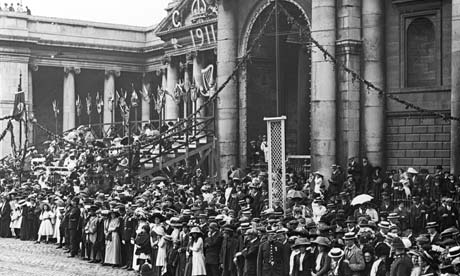
Picture of George V’s visit to Dublin in 1911 – from The Guardian

In just two days, Queen Elizabeth II will be arriving in Dublin – just a few hours after I leave for Berlin.  I am actually quite happy to be missing the royal visit, and that other semi-royal visit of President Obama returning to the country of (a few of) his ancestors.  But American presidents have visited Ireland before, and despite attempts by the press and the Irish government to cast it as inter-stitial business as usual, the Queen’s visit is actually quite a big deal.  The last British monarch to visit Ireland was King George V in 1911- which means that no British monarch has ever visited the Republic of Ireland. Put another way, no British monarch has ever visited the 26 counties when they didn’t belong to the British empire.
The range of responses to the Queen’s visit is fairly broad.  The establishment seems to be bending over backwards to convince both the Irish people and the world that the visit is a certified Good Thing.  Speaking to the Guardian, tánaiste Eamon Gilmore (the tánaiste is the deputy to the taoisach, who is the leader of the Irish government) said “She is the head of state of a neighbouring country and state visits are very much part of what we do. She will get a very warm welcome. Her visit will herald a much more normal relationship between Ireland and the UK.”  RTÉ is running a program tonight on the life of the Queen, which looks to be about how QEII is really a nice normal lady who happens to be a Windsor.

Protest website associated with the Cork English Market

I think that a lot of people who bother to think about the visit at all, wonder if there can ever be a normal relationship between Ireland and the UK. I also don’t think that acknowledging how complicated the Anglo-Irish relationship is, is a bad thing.  After all, for many in the 26 counties of the republic and the 6 counties in Northern Ireland, a British presence in the North is considered an unwarranted military occupation.  The security arrangements that are being taken to protect the Queen point to the ways in which this is not a normal state visit.  The press has widely discussed whether it is wise for the Queen to visit the Garden of Remembrance which honours those who died “for the cause of Irish freedom,” especially in light of promises made by Republican groups to occupy the garden and surrounding areas in the days before the visit.  Of even greater concern is her proposed visit to Croke Park, where in 1920, British troops took the field in armored vehicles and fired into the crowd watching a Gaelic football match, in retaliation for IRA killings of British intelligence officials earlier in the day.  As The Guardian noted “It is not so very long since no Briton could have set foot there, let alone a British monarch.”
There are people – I have met people – who remember living in an Ireland where British colonialism was real, often brutally so.  Although the generation who lived through the Irish war for independence is now mostly dead, there are still OAPs who were children in the 1920s, and who grew up in an occupied 26 counties.  Although these wounds are rawer and more recent in the North, where the events of ‘Bloody Sunday’ and the hunger strikes have very present repercussions – to assume that they are healed in the Republic is, I think naive.
One of the themes in news reports leading up to the Queen’s visit is the importance of memory and anniversary in Irish culture.  Assertions that the Irish are obsessed with the past has overtones of accused mysticism that are very much part of a political tradition where the Irish are cast as dreamers or as unnecessarily mired in the history of their country.  I think that some of these tropes, particularly the seething anti-British Irishman clutching at resentment that has (nominally) been laid to rest in the Northern Irish peace process effectively obscures some of the very real concerns that some people have about what it means for a British monarch to visit Ireland without making some move to atone for British sins.
In contrast to mainstream normalization, Éirigí, a political group that trends younger than many Republican movements, and which calls for “a socialist [Irish] republic” presents this list of questions about the royal visit:

  • Why should the people of Ireland be expected to welcome the head of state of a country that continues to occupy the Six Counties? 
  • What message does this visit send from the Twenty-Six Counties to those who live under the British occupation in the Six Counties? 
  • Why should upwards of €20,000,000 be spent hosting such a controversial state visit at a time of unprecedented economic depression? 
  • Is this visit really about improving relations between the peoples of Ireland and Britain, or is it about reinforcing the British occupation?”

I understand the impulse to normalize this visit – an impulse I imagine is in service of limiting violent protests – but rather than talk about it as if it were simply a long overdue formality, I think it would be well for those claiming ‘no big deal’ to actually engage with the arguments of people who oppose it.  To dismiss their objections as wrong headed or mired in the problems of the past is to disregard a historical relationship very much at the heart of modern Ireland, and a missed opportunity for people with very different ideas about the place of Ireland in the British archipelago, in Europe and in the world to honestly debate Ireland’s future.

Typhoid, Montclair and service learning

As a side project, C and I are trying to put together a curated New York City walk.  We’re starting with a public health theme, centered on the story of “typhoid” Mary Mallon, perhaps the most famous silent carrier in American history.  It’s easy to see epidemics like typhoid as urban problems, and many health experts throughout history have prescribed a clean air rest cure exactly because the close, airless conditions that are common in cities were thought to be insalubrious.  (An aside, at a recent talk at NYU David Oshinsky argued that Roosevelt’s polio might be traced to just such a proscription for clean air.  Oshinsky thinks that stress from Congressional hearings about gays in the Navy combined with a vacation that featured vigorous outdoor activity and swimming in the Bay of Fundy made Roosevelt particularly susceptible to the polio virus, which he might have picked up while visiting a boyscout jamboree in 1921.)  I came across another counterexample while looking for an organic dairy that would deliver near where I live.  In 1894, the New York Times reported a “local epidemic of typhoid fever in Montclair, NJ” that was traced to a Verona milkman named G.W. Gould.  There’s no particular revelation here – typhoid can be spread through a number of media and food was historically one of the most common.
Having recently re-worked my statement of teaching philosophy – in which I lay a great deal of emphasis on encouraging students to think of history in terms of human consequences rather than a litany of facts, this article on the Montclair typhoid epidemic served as a nice reminder of the ways in which academic history can intersect in unexpected ways with “real” life – and reminds me how much I want to destabilize the model that deliniates between life in the ivory tower and everything outside of it.  The “service learning” concept, which is used by some colleges to encourage their students to “not only learn the practical applications of their studies, [but also to] become actively contributing citizens and community members through the service they perform,” satisfies this need admirably.