Snarky bureaucracy, c. 1846

I’ve finally tracked down the files containing army correspondence relative to Fort Gibson, in Indian Territory, around the time that the Cherokee Nation raised funds for famine relief.  Many of the letters are about troop movements, but the one I’m reading now is crabby about whoever is responsible for the fort’s finances:

You are mistaken in supposing that the regulation of July 12th, 1845 went into operation at Fort Gibson only from the date of its recipt at the post (August 10th).  The Regulation, like an act of any legislature, takes effect from its date.

And:

The explanation in reference to the large amount paid for garden seeds is not entirely satisfactory.

IVMOOC text

There are lots of reasons to be leery of MOOCs, but I very much enjoyed the information visualization MOOC run out of Indiana University last year.  The visualization I helped produce is previewed here, under case study #5.  I spearheaded the mapping part of the project, and proposed the color model we ended up using in which different hues represented different changes in publication rates between two periods.  Nice to see it in (almost) print!

Sleepy Hollow continues to be weird

My students asked today for a Sleepy Hollow update – which I wasn’t fully prepared to give.  After they found the Lost Colony of Roanoke (on a magic island in the Hudson Valley, no less), I had sort of given up on the show.  I caught up tonight – and it continues to be terrible, but in some rather odd ways.

For one, some officers of the British army are also demons, which takes the moralization of American history that the show has been doing all along to new and strange places.  The premise is that Washington and a band of good guys was tasked with protecting the world from evil (via the British), so perhaps its not surprising that the writers decided to literally demonize British officers.  Nevertheless, it seems like a very literal way to make the point that Americans were the good guys in this fight, and the British were the bad guys.

The second sort of bizarre thing was that Ichabod’s wife, the witch, who was burnt at the stake in 1782 (she wasn’t really killed, but not because there weren’t witch trials in the late 18th century) is first introduced to Ichabod as a Quaker nurse.  It’s not clear if she was also a witch at that point – but it struck me as odd that her Quakerness and witchyness seemed so easily integrable.  I’m not an historian of religion, but it seems like the writers might have surmised that since Quakerism today allows a fair amount of latitude in terms of religious practice, perhaps 18th century Quakerism did too.  It does, though, seem like a very marginalizing move, to cast Quakers as insufficiently religiously serious to object to one among them also being a witch.

Finally, the witches were allied with the Freemasons, which I have no way to explain.  I’m teaching the U.S. survey again next semester, and I’m trying to figure out how to use one of these episodes in class.  With popular historical perspectives this semester – in particular Ask a Slave and the soundtrack to Bloody Bloody Andrew Jackson – I didn’t give my students enough of a framework to talk about the sources.  They thought that Ask a Slave was funny and that Bloody Bloody was selectively accurate, and a bit vulgar, but I need to find a better way to connect the production of popular historical material to what they’re learning in class.  In the past, I’ve asked students to evaluate pop history in light of what they’ve learned in the class so far – but since we don’t get to Washington’s plantation, Andrew Jackson or the American Revolution until the middle of the course, I’m on the lookout for something that I can ask them to consider in the first few weeks, or that they can use as a jumping off point for their first set of response papers.  Perhaps the Roanoke episode of Sleepy Hollow (or, for that matter, Supernatural) might fit the bill afterall.

On the embargo question

I’d been waiting to start this until my dissertation abstract was actually available through Proquest, but I’ve recently learned that it might take as few as 8 and as many as 20 weeks (~2-5 months) from the time NYU submitted the darned thing, which was three months after I submitted final revisions, to appear.  That’s between 5 and 8 months between my final version and the world of accessible-via-Proquest.  This, frankly, seems like something worth throwing into the debate about embargoing.  I embargoed my dissertation – largely because of some truly horrible stories I’d heard from people who found their work used by more senior scholars, or in more cases, had found that the archival road-map laid out in their dissertation had been used by someone else to publish more or less the same argument before they’d been able to get a book contract.  I know that there are many and varied reasons not to embargo, and I’m toying with the idea of asking Proquest to lift it, but as a junior, untenured scholar, the risks seem to outweigh the reward.

That being said, as an advocate for the digital humanities generally, and as someone who has benefited from open-source dissertations particularly (an aside – what I’d really like to see is for the AHA to have some mechanism for young scholars to make their dissertations widely available, and to work with acquisitions editors to create a culture where an available dissertation is almost never an impediment to a book deal.  The former, because I find it frustrating that my only venue for dissertation publishing is through a for-profit company) I’d like to make some of my work generally available to a wider audience.  It seems like conference papers are a good place to start.  For one, this is intellectual work that’s already been put out in a public space (though attendance at conferences and particular panels obviously varies), and for another, a lot of the material I’ve presented at conferences over the years has been excised from the dissertation, or changed so much as to make it truly different work.  In that spirit, I’ve created a new page here – one at which I’ll post selected delivered conference papers that aren’t a part of anything that’s currently in process or out for review.

I’d also like to say – both in this post and at that new page – that I’m happy to share my dissertation with anyone who wants to see it.  Just e-mail me and ask.  I know that this is far from the spirit of true open source access to academic work – but for me it’s a start.

Archival gem (on stereotypes)

I took a trip down to Charleston today to look at the records of the Charleston Hibernian Society – the body that collected donations for famine relief in Georgia, South Carolina and North Carolina.  All told, these men took in approximately $15,000, and letters to the English consulate in New Orleans suggest that still more donations were made directly to British representatives in America.  Sadly, the 1886 Charleston earthquake seems to have destroyed the minute books between February of 1847 and early 1857, so there was less than I’d hoped for.  Nevertheless, I’ve come away with a list of members of the Charleston Hibernian Society to crosslist (and hopefully map) against the list of donors I’ve already assembled.

I also came across this delightful budget from February of 1847 –

The Treasurer Reports having paid the following bills:

Hayden & Gregg for Lamps                           $         3.38

To Patriot for Advertising                                          17.50

G W Black for Building Drain                                    157.22

Stevens & Betts for Spittons & Spade                     4.62

Stephen Jones for Repairing fence in yard             3.37

And for 1 Doz Porter                                                  3.25

Aside from whatever was going on with that drain (G.W. Black was admitted to the Hibernian Society at the same meeting that bill was submitted, and seems to have been related to other members of the society, so I couldn’t help but wonder whether he was getting some kind of kick-back), I very much appreciate that a dozen porters could be bought for the same price as lamps or fence repairs, and that whoever bought those beers saw fit to charge them to the Society.  The treasurer’s books also featured several remittances for whiskey.

Google map engine and Charleson donors

Although the Google map engine API is meant for businesses, there’s a lite version for non-business map geeks.  I like this tool because it’s easy to embed a lot of data into the map.  Here’s a quick version of the Charleston famine donors map that I’d previously made just using Google maps and dropping “pins” in places where donors were located:

[googlemaps https://maps.google.com/maps/ms?msa=0&msid=214677819635357292007.0004d08361291f904d1c3&ie=UTF8&t=m&ll=34.016263,-82.283671&spn=3.169364,6.305034&output=embed&w=425&h=350]

All of these donations were printed in Charleston newspapers, and when I first started mapping them I was struck that (1) many of the donors printed in Charleston papers didn’t seem to live in Charleston and (2) how many of them were slaveowners.
The new map is here.

Quick note: Henry Street, New York, 1847 – a particularly philanthropic street?

Building on the patterns I’ve been trying to track in famine donors, I also noticed today that of the thirteen individual donors from New York City, nearly a quarter lived within a few blocks on Henry Street.  I don’t know what it’s about, or if it’s just a random happenstance but I’ve got a whole other list of NYC donors and I look forward to finding out!

Henry Street via NYPL

On starting new projects

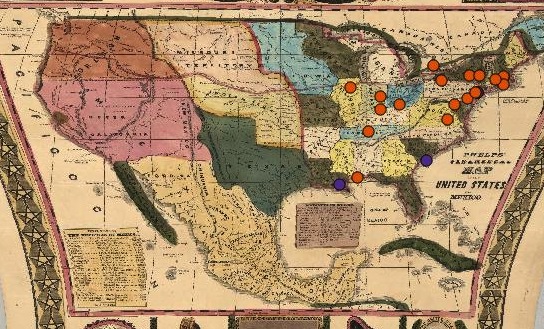
I’m deep in the next-year’s-research planning phase of the summer, which is mostly comprised of figuring out what other donor communities I want to look at for the book manuscript.  I chose sites for the dissertation largely based on news production – locales in which a lot of news was being produced, reproduced and consumed – but for the book I’ve been thinking about how to better center the experiences of non-elite donors, which means looking for places from which donations flowed, rather than places in which people were merely reading about the famine in Ireland.  As part of this, and as part of a related project to collect the names of donors to a wide range of 19th century philanthropic projects, I’ve been working on a database which tracks not only individual donations, but also biographical information about donors.  I’ve been using this data – and in particular donations to national famine relief funds (the American Society of Friends rather than the New York Irish relief committee, for example) to try to map places where donations came from, but that I haven’t yet explored.

So: a very few, very preliminary findings:

  • Most of these donations are coming from cities.
  • Many are on behalf of relief committees of entire cities – it’s not clear yet whether these are Quaker relief committees or ones without religious (or with another religious) affiliation, but I hope that’s something I’ll be able to check out at the Haverford Quaker archives.
  • Of those donations made on behalf of urban relief committees, the people doing the collecting were almost entirely merchants.

The orange circles are the places I’ve yet to explore – lots to do!

CRC donor locales

Life after defense

Finishing a PhD is not easy: a truism if ever there was one.

I started grad school on September 6th, 2006 (2455 days ago), defended on February 13th (105 days ago), submitted on May 10th (18 days ago) and graduated on May 20th (8 days ago.)  When people talk about how hard it is to finish a PhD, many of them mean in terms of time – I’ve been in school for my entire life (barring those first pre-ambulatory years) and in grad school for fully a quarter of my life.  It’s a long, at times grueling process.

I don’t have word or page counts for everything I’ve written in the last seven years, though I’m sure the numbers are also staggeringly high.  When I finally put together my dissertation pdf, I was amazed that it was over 200 pages long.  I didn’t remember writing 200 pages, but there it was, seven years’ worth of thinking, (somewhat) neatly arranged in 283 pages of text.  This is another one of the ways in which finishing might be seen to be difficult, producing a book-length manuscript, and particularly producing a book-length manuscript for the first time might be considered by many to be a difficult undertaking.

Both of these senses of not-easyness certainly felt true to me, but for the past few months, when I’ve talked about finishing being difficult, I’ve meant something else entirely – and something that I think we don’t talk about very much.  Because the whole graduate school experiences culminates in that final defense/submission/hooding, there’s very little conversation about what it means to put behind you – however briefly – a project that’s defined your life for the better part of 5 or 6 or 7 or 8 or more years.  There’s very little conversation about how difficult it is to leave a formative intellectual community – a community of scholars, but also of friends and conspirators and supporters.  And there’s very little conversation about what seems to be – from an informal survey of my friends and mentors – of how to grapple with loving a project, but kind of hating the form that the dissertation took, if only because it’s really only after we’ve finished this iteration that we can see the changes we want to make for the book.

All of this is, of course, tempered by pride at being finished, by the post-defense “oh my gosh I get to sign things PhD” and (hopefully) but the giddy apprehension of starting a new job, but between my defense and now, I’ve often found myself thinking that a kind of post-grad school support structure would be a good idea, and that frank discussions about what it means to launch ourselves into the world – for many of us, for the first time – as non-students, wouldn’t undermine all of that joy one bit, but would make the leaving a little less bitter and a bit more sweet.